
CPiQ · Co-Parenting Intelligence
Better co-parenting starts with better communication.
Introducing CPiQ: a smarter way to communicate with your co-parent, reduce unnecessary conflict and keep conversations focused on what matters most, your children.
 Developed by Dallas family law attorney and parenting facilitator John B. Polk and Emily Polk.
The problem
When every message feels like an argument.
After a divorce, most co-parenting happens in text messages and emails. A late pickup, a school form, a doctor visit. One sharp sentence turns a schedule question into a fight, and the children feel it.
CPiQ sits between the message you want to send and the one you actually send. It points out what will land as blame, and suggests wording that asks for what you need.
Before CPiQ
You never tell me anything! Why am I always the last to know about the kids?
- “never” and “always” read as accusations
- The question is buried under the complaint
After CPiQ
Could we agree to share important updates about the kids as soon as possible? I’d appreciate being kept informed so we can plan together.
- Asks for one specific thing
- Keeps the focus on planning for the kids
Illustrative example written for this page. It is not a real user’s message and not actual CPiQ output.
How it works
Three steps, every time you hit send.
- 01
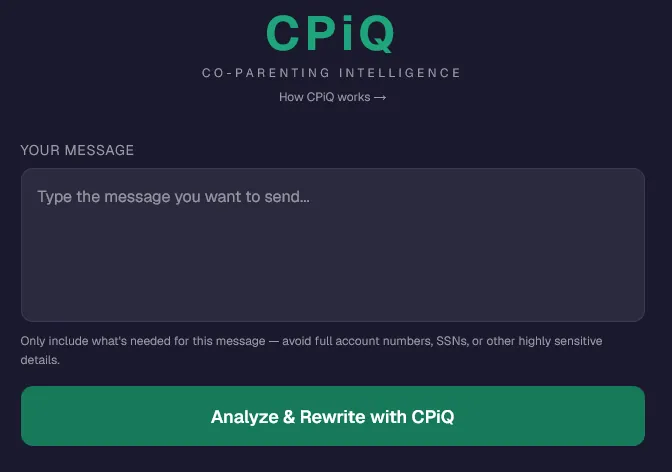
Write it the way you feel it
Type or paste the message you are about to send your co-parent. Include only what the message needs: no account numbers or other sensitive details.
- 02
CPiQ analyzes and rewrites
It scores the tone and suggests a version that is clearer, calmer and more child-focused.
- 03
You decide what to send
Review the suggestion, edit it in your own words and send it the usual way. You stay in control of every message.
Feature 1
The Translator
Paste a message before you send it. CPiQ’s message analyzer gives it a score and its rewriter suggests a version that is clearer, calmer and more child-focused.
- See which words will read as blame or sarcasm
- Get a rewrite that keeps your point and drops the heat
- Edit the suggestion before you send it: AI suggestions can be wrong
Feature 2
The Lessons
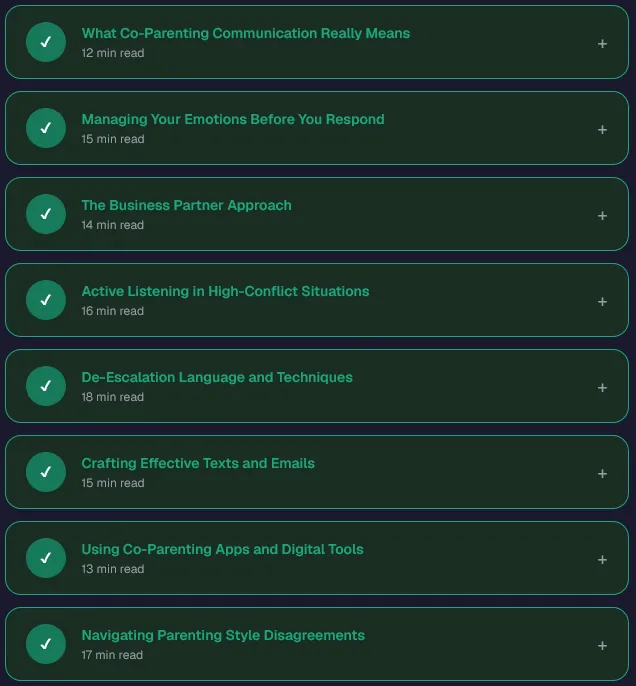
Twenty short lessons, about 15 minutes each, on managing emotions, de-escalating conflict and keeping children out of the middle. Quizzes check what you learned, and finishing the course earns a certificate of completion.
- Lessons such as “Managing Your Emotions Before You Respond”, “The Business Partner Approach”, “De-Escalation Language and Techniques” and “Crafting Effective Texts and Emails”
- Short enough for a lunch break, built on parenting-facilitation methods
- The certificate documents CPiQ’s own course; it is not issued by a court
Feature 3
Your progress
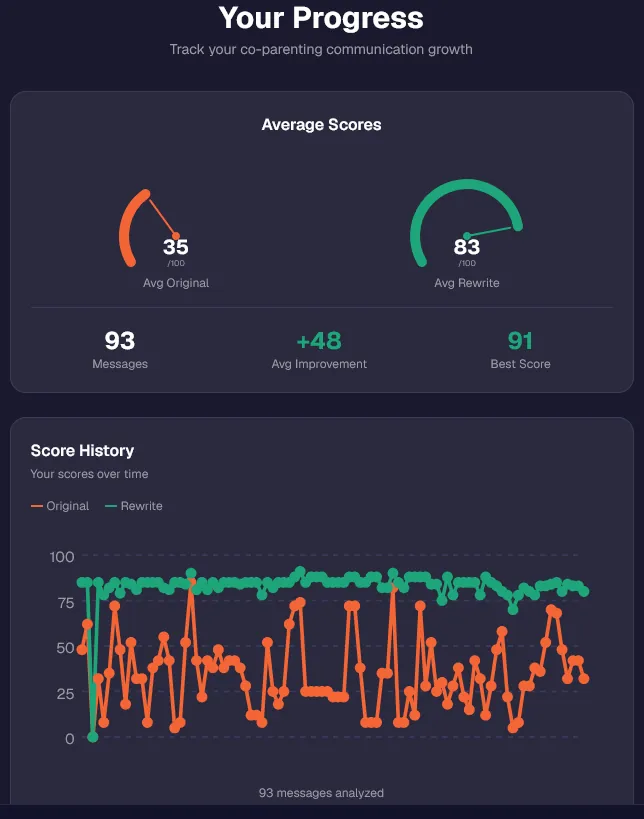
Communication scores, badges and a history of your messages show how the tone of your co-parenting changes over time, and how far you are through the lessons.
- Your average score before and after rewriting
- A score history across every message you analyzed
- Lesson progress and badges in one place
Try it on the next message you were about to send.
Write it the way you feel it. Send the version that helps your children.

John B. Polk
The story behind CPiQ
Built from real family law and parenting facilitation experience.
John B. Polk has served Dallas–Fort Worth co-parents as a parenting facilitator since 2012. In that role he sees the same pattern again and again: parents who agree on almost everything still end up in conflict because of how they say it.
John and his wife, Emily Polk, developed CPiQ to put that coaching in a parent’s pocket. As they explained on The Melinda Eitzen Show (September 17, 2026), the app was built from more than 100 hours of John’s facilitation transcripts, the Texas Family Code and co-parenting best practices.
That is the difference from a general writing assistant. A general chat tool tends to agree with the person typing and help them make their case. CPiQ is built to do what a parenting facilitator does: steer each message back to the children and away from the fight.
Who CPiQ is for
- Co-parents who agree on the big things but argue over logistics
- One parent who wants to lower the temperature, even if the other does not join
- Parents working with a parenting facilitator who want practice between meetings
- Anyone who has sent a message at 11 p.m. and regretted it at 7 a.m.
What CPiQ is not
- A case where family violence is alleged: CPiQ says it is not an appropriate tool there
- An emergency: call 911 or the right crisis line
- Legal advice, therapy or a court-ordered parenting course: CPiQ is none of these
Co-parents stuck on a decision may need a parenting facilitator, not an app. How parenting facilitation works.
Price
$99 for the first three months
then $33 a month until you cancel
- Cancel anytime from your Account page
- Payments already made are not refundable, except for billing errors
- For adults 18 and older
Run by CPIQ, LLC (Texas). Prices from CPiQ’s terms, November 2026.
CPiQ questions
What is CPiQ?
CPiQ (Co-Parenting Intelligence) is an online coaching tool for co-parents. It analyzes messages you are about to send and suggests calmer, clearer, child-focused wording, and it includes a 20-lesson co-parenting course with a certificate of completion and a record of your progress. It was developed by Dallas family law attorney and parenting facilitator John B. Polk and Emily Polk, and is run by CPIQ, LLC.
How does CPiQ help with co-parenting communication?
It works before the message goes out. CPiQ scores the tone of your draft and suggests a version that asks for what you need without blame, so fewer conversations turn into arguments. The lessons teach the same skills so you need the rewriter less over time.
Can CPiQ help rewrite an emotional message?
Yes. That is what the Translator is for: paste the heated version, and CPiQ suggests a calmer one that keeps your point. Always read the suggestion and adjust it before sending, because AI-generated suggestions can be inaccurate.
Can I use CPiQ if my co-parent doesn’t use it?
Yes. CPiQ works on the messages you write in your own account, and nothing in its terms requires the other parent to sign up. Changing your side of the conversation is often what lowers the temperature on both sides.
What is the difference between CPiQ and a regular messaging app?
CPiQ is not a messenger. You still send messages the way you do now, by text, email or the co-parenting app in your court order. CPiQ coaches the wording before you send and teaches the skills behind it, which a messaging app does not do.
Is CPiQ legal advice?
No. CPiQ is not a law firm and does not give legal advice, it is not a mental health service, and it is not designed for emergencies. It is also not an appropriate tool where family violence is alleged in your case. Its certificate documents CPiQ’s own course and is not presented as satisfying a court-ordered parenting class. For legal questions, talk to a lawyer.
Is my personal information private?
According to CPiQ’s privacy policy, the text you submit is sent to an outside AI provider to produce the analysis, CPiQ does not use the content of your private messages to train public or third-party AI models, and it does not sell personal information. If you delete your account, CPiQ says data is removed from active systems within 30 days and from backups within 90 days. Include only what a message needs and leave out account numbers, Social Security numbers and other sensitive details.
How do I get started?
Go to cpiq.ai and create an account; you must be 18 or older. Access costs $99 for the first three months, then $33 a month until you cancel, which you can do anytime from your Account page. Payments already made are not refundable except for billing errors.
Does a court or a parenting facilitator require CPiQ?
No. A judge, attorney or parenting facilitator may suggest it, but CPiQ’s terms say a professional may not require you to use it, and using it does not create an attorney-client relationship with anyone.
CPiQ · Co-Parenting Intelligence
Fewer arguments. More focus on your children.
CPiQ is a coaching tool, not legal advice, therapy or parenting facilitation. Need a lawyer, a mediator or a facilitator instead? Contact John B. Polk’s office.